
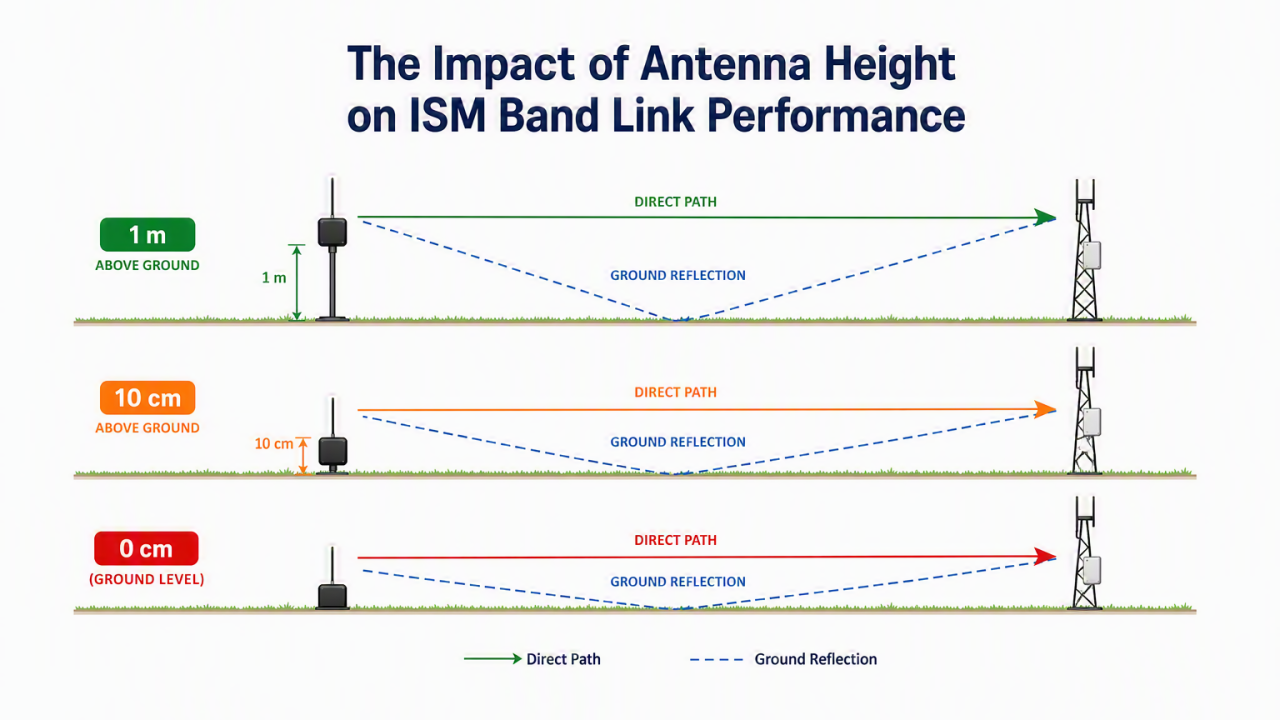
"10 cm" means something different at 433 MHz than it does at 2.45 GHz, because what actually governs these effects is height measured in wavelengths (λ): At 433 MHz (λ = 69.3 cm), 10 cm is only 0.14λ, and 1 m is 1.44λ. At 915 MHz (λ = 32.8 cm), 10 cm is 0.31λ and 1 m is 3.05λ. At 2.45 GHz (λ = 12.2 cm), 10 cm is already 0.82λ and 1 m is 8.2λ. That's why 10 cm barely helps at 433 MHz but does noticeably more good at 2.4 GHz — it's a much larger fraction of a wavelength at the higher frequency. Ground level (0λ, by definition) is the worst case at every frequency, with no exceptions.
Effect #1: the ground isn't just a reflector, it's a lossy load on the antenna
A small antenna within a fraction of a wavelength of the earth is electromagnetically coupled to it in real time, not just bouncing a wave off it later. Image theory explains why: place a mirror-image antenna below the ground plane, and for a horizontally oriented radiator very close to that plane, the real antenna's current and its image end up driven out of phase — cancelling much of the radiation in the directions you actually want it to go. Because real ground is a lossy dielectric rather than a perfect conductor, that cancellation isn't total, but the power that "fills in" the pattern null isn't a win — it's mostly being absorbed as heat in the soil. This is well-documented, if under-appreciated outside HF antenna circles: a horizontal dipole at around 0.1–0.15λ height is commonly cited as running at roughly 50% radiation efficiency, with a rough rule of thumb that doubling height in this low regime buys about 6 dB. The mechanism doesn't care whether you're at 7 MHz or 915 MHz — what matters is height in wavelengths, and 10 cm at 433–915 MHz sits in exactly that electrically-low regime. There's ISM-specific evidence too. Published work on soil-contact sensor antennas shows that a modest change in ground moisture alone can shift antenna matching enough to swing signal level by roughly 10 dB in bench testing and up to 40 dB in full-wave simulation. That's exactly why purpose-built "buried" or "near-ground" antennas exist as their own design category, rather than everyone just using an off-the-shelf whip. Bottom line: at true ground level, expect real — sometimes severe — radiated-power loss purely from ground coupling, independent of the receiver. At 10 cm, the penalty is real but frequency-dependent. At 1 m, for every common ISM band, the antenna is comfortably clear of this effect.
Effect #2: the two-ray ground-bounce law
Now assume all three antennas radiate their full 25 mW efficiently — isolating the second effect. A distant receiver sees two paths: the direct ray, and a single dominant ray reflected off the ground in between. Close in, those two rays add constructively. Farther out, they cycle in and out of phase. Past a "breakpoint" distance, the geometry settles into a stable, worse-than-free-space relationship where received power falls off as the inverse fourth power of distance — 40 dB per decade instead of free space's 20 dB per decade. The breakpoint distance is d_b = 4·h_t·h_r/λ, and beyond it, received power depends on transmit height squared. That squared term does all the work in this comparison. Take a receive antenna at 10 m (a typical mast-mounted gateway) and 915 MHz. The breakpoint sits at roughly 12 m for a 10 cm transmit height, and roughly 122 m for a 1 m transmit height. At 500 m range — past breakpoint either way — received power comes out to about −74 dBm at 1 m transmit height, about −94 dBm at 10 cm, and about −114 dBm at ground level. That's a clean 20 dB per tenfold change in transmit height. Ground level is worse than either raised case for a structural reason, not just a magnitude one: a transmitter right at the surface puts the direct and reflected rays at nearly the same grazing angle, where the ground's reflection coefficient sits close to −1 at every distance, not just beyond some breakpoint. There's no favorable near zone at all — you inherit the destructive 40 dB/decade behavior from very short range onward.
Worth noting: this height-squared penalty is essentially independent of frequency once you're past breakpoint — unlike the near-field effect, which very much depends on frequency.
Effect #3: the ground gets in the way of the Fresnel zone too
Even calling a near-ground path "line of sight" is generous, because a real RF path needs clearance around the direct line — the first Fresnel zone — to behave like free space. At 915 MHz, that zone's radius at the path midpoint is already about 2.9 m for a 100 m link, 6.4 m for 500 m, and 9.1 m for 1 km. A transmitter and receiver both within a metre of open, flat ground have that entire zone obstructed by the earth itself — no vegetation or obstacles required. This isn't just theory. A published near-ground channel study at 868 MHz, 2.4 GHz, and 5.8 GHz, with antennas at 0.2 m and 0.4 m over soil, short grass, and tall grass, fit a three-slope path-loss model explained directly by first-Fresnel-zone obstruction. The extra loss near the ground isn't only a two-ray artifact — it's genuine diffraction loss from the earth physically intruding into the Fresnel volume, compounding rather than replacing the two-ray effect above.
Putting it together
Ground level is the worst case at any distance beyond a few metres — range becomes short-haul and highly sensitive to soil moisture and weather. Ten centimetres is usable but noticeably worse than a metre, with a frequency-dependent efficiency penalty on top of a still-tight breakpoint. One metre is the clear winner: it clears the worst near-field ground coupling at every common ISM frequency, pushes the breakpoint out roughly tenfold, and gives meaningfully better Fresnel clearance. Because the two mechanisms stack in the same direction, the real-world gap between "on the ground" and "1 m up" is often larger than either effect alone would suggest — easily 20–40+ dB at typical link distances. For context, that's comparable to or larger than the difference between a 0 dBi antenna and an 11 dBi one.
Practical takeaways
A modest lift off the ground is disproportionately valuable — going from 0 to 10 cm captures a large share of the benefit, and going on to 1 m captures most of the rest. The improvement isn't linear with height; it's roughly 20 dB per decade of height increase in the far-field regime, so the first few centimetres matter more, proportionally, than the last few tens of centimetres. Frequency matters for the near-field piece (433 MHz suffers more than 2.4 GHz at the same physical height) but barely matters for the far-field piece once you're past breakpoint. When ground level is unavoidable — buried soil-moisture probes, under-slab sensors, agricultural monitors — don't expect raised-device range from the same transmit power. Purpose-built near-ground antennas claw back some of the matching loss, but these deployments still typically lean on shorter link distances, denser gateways, or relay nodes rather than trying to out-power the propagation penalty. And this stacks independently with antenna gain: raising a ground-level device from 0 to 1 m doesn't change what a high-gain receive antenna does for you, and vice versa. Both belong in the same link budget.
If you're deploying ISM-band or LPWAN sensors anywhere near ground level, height is very likely the cheapest, highest-leverage lever you haven't pulled yet.
#RFEngineering #AntennaDesign #RadioPropagation #LoRaWAN #IoT #WirelessCommunications #LinkBudget #WirelessNetworking
